
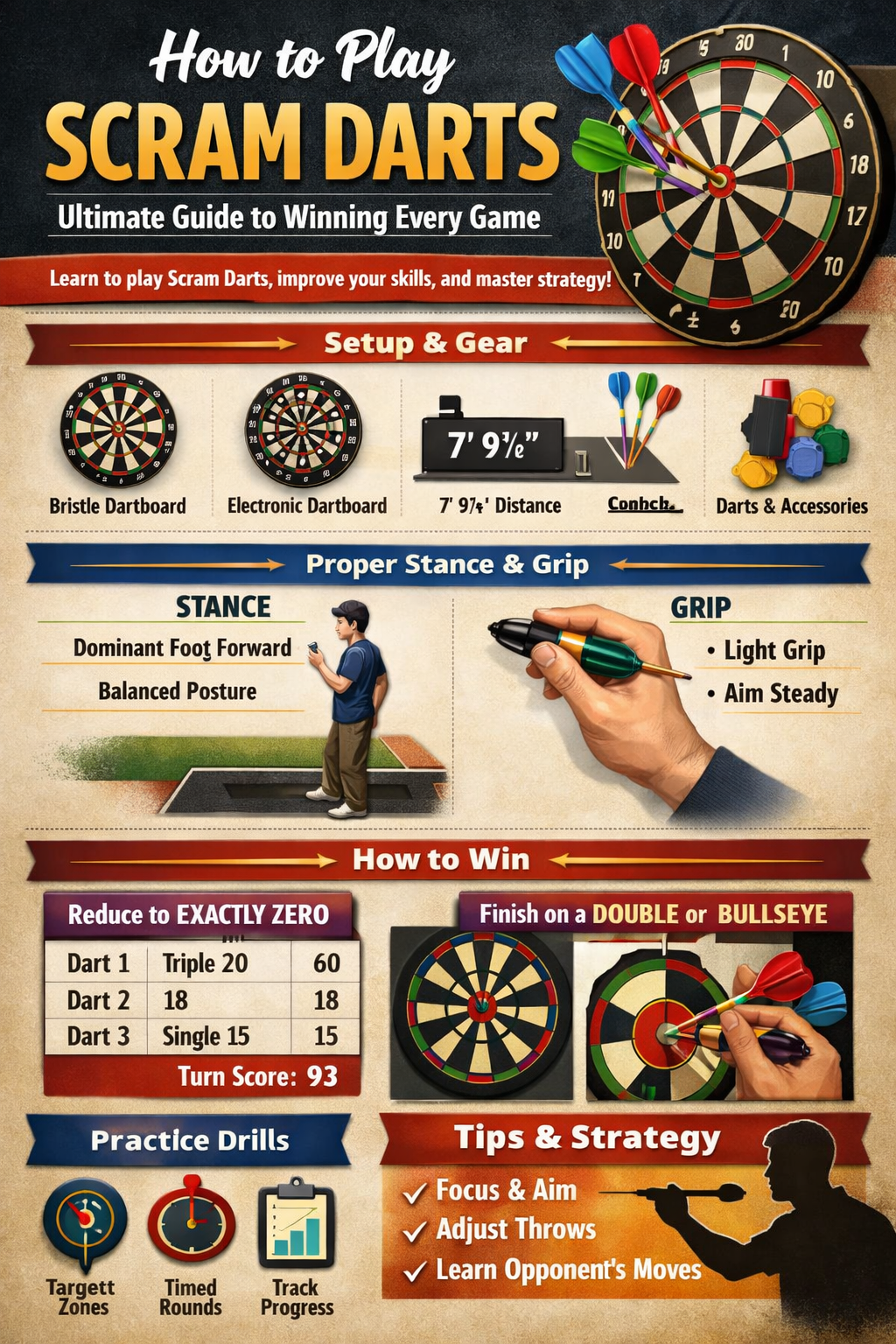
Scram Darts is an exciting, fast-paced variation of darts that blends strategy, precision, and mental focus. Unlike classic games like 501 Darts, Scram Darts challenges players to think quickly, adjust tactics on the fly, and hit precise targets.
Whether you’re a beginner looking to learn or an experienced player aiming to improve, this ultimate guide will teach you everything you need to know: setup, stance, throwing techniques, scoring, advanced strategies, practice drills, and even gear recommendations. By the end, you’ll have the tools to dominate any Scram Darts match.
1. What is Scram Darts?
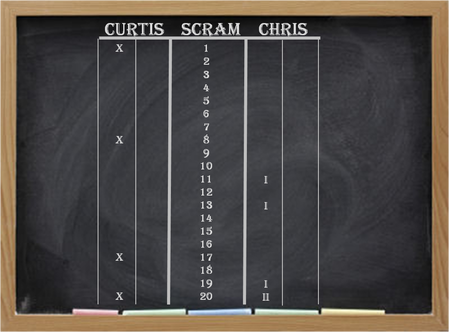
Scram Darts is a competitive darts game where players take turns throwing three darts per round, aiming to reduce their starting score (often 301 or 501) to exactly zero. The twist is its strategic gameplay: each throw affects not just your score but also your opponent’s options.
Unlike casual dart games, Scram Darts emphasizes:
Quick decision-making: Adjust your strategy based on score and opponent progress.
Precision: Small adjustments in aim can make a big difference.
Mental agility: You need to anticipate your opponent’s moves and plan your throws.
Scram Darts is perfect for game nights, competitive play, or solo practice. For fun alternatives to improve your skills, check out:
How to Play Knockout Darts – elimination-style gameplay.
How to Play Around the Clock Darts – perfect for precision practice.

Credit: www.youtube.com
2. Setting Up Scram Darts: The Essential Steps
A proper setup ensures fair play, consistency, and comfort. Let’s go step by step.
2.1 Choosing the Right Dartboard
Your choice of dartboard can make a huge difference. You can opt for:
Bristle dartboards: Durable, self-healing, and ideal for steel-tip darts.
Electronic dartboards: Perfect for soft-tip darts and automated scoring, making them beginner-friendly.
For budget-friendly options, see: Best Electronic Dart Board Under $100.
2.2 Measuring the Space
The standard setup requires:
Throwing distance: 7 feet 9 ¼ inches from the oche to the board.
Clearance: At least 5-6 feet of free space around the oche for safe play.
Check out: How Much Room Do You Need for a Dart Board: Essential Guide for full guidelines.
2.3 Player Roles
Decide who throws first and maintain a set turn order. Each player throws three darts per turn, and scores are tracked carefully. Clear roles prevent confusion during gameplay.
2.4 Accessories and Gear
The right accessories improve performance:
Beginner darts: Best Darts for Beginners
Dart mats for consistent stance and oche markers
Scoreboards or apps for tracking points automatically
3. Stance and Grip: The Foundation of Accuracy
Your stance and grip are the pillars of a consistent throw. A proper foundation reduces fatigue and maximizes control.
3.1 Perfect Stance
Foot placement: Dominant foot forward, knees slightly bent.
Body posture: Keep upper body straight and relaxed.
Weight distribution: Evenly across both feet, avoiding leaning forward or backward.
A stable stance ensures every throw is repeatable and precise. Advanced stance tips are covered in Improve Your Darts Stance: Master Techniques for Precision.
3.2 Proper Grip
Hold the dart lightly with thumb, index, and middle fingers.
Avoid squeezing tightly—this causes tension and reduces accuracy.
Adjust grip based on dart type: steel-tip vs soft-tip.
A smooth, light grip allows the dart to glide from your hand cleanly, improving trajectory and precision.

Credit: darthelp.com
4. Mastering the Throw: Step-by-Step
Throwing a dart may seem simple, but mastering technique is crucial.
4.1 Pull Back Motion
Slightly bend your elbow as you pull the dart back.
Keep your movement smooth; jerky motions reduce accuracy.
4.2 Smooth Release
Push the dart forward in a straight line toward the target.
Release gently, letting go without gripping the dart tightly.
4.3 Follow Through
Extend your arm fully after releasing the dart.
Maintain hand alignment toward the target to guide the dart.
For advanced throwing strategies, visit Master Your Dart Throwing Technique: Achieve Precision and Control.
5. Scoring and Rules in Scram Darts
Understanding scoring and rules ensures fairness and enjoyment.
5.1 Turn Structure
Each player throws three darts per turn.
Turns alternate until a player reaches zero points.
5.2 Scoring System
Players start with a set score (commonly 301 or 501).
Each dart reduces the score based on where it lands.
Bust Rule: If a throw exceeds the score needed, points reset to the previous total.
5.3 Winning Conditions
First player to reach exactly zero wins.
The final dart usually must land in a double or bullseye (optional for casual games).
Scram Darts combines the precision of 501 Darts with the strategic twists of other dart variations.
Credit: www.dartspiks.com
6. Accuracy and Mental Focus
Consistency in Scram Darts comes from practice, focus, and attention to detail.
6.1 Staying Still
Keep shoulders and torso steady.
Let the arm do the work, avoiding whole-body movement during the throw.
6.2 Aiming Techniques
Visualize an invisible line from your eye to the target (the “string method”).
Focus on the segment you want to hit, rather than the board as a whole.
6.3 Regular Practice
Short, frequent sessions are more effective than long, tiring ones.
Track scores and aim for small incremental improvements.
For a fun way to practice targeting, check out: How to Play Around the Clock Darts.
7. Advanced Strategy
Scram Darts is a game of skill and strategy.
7.1 Reading the Board
Identify high-scoring areas and doubles.
Observe opponents’ patterns and adjust your throws strategically.
7.2 Adjusting Throws
Softer throws for tight targets, stronger throws for larger ones.
Modify angles or release based on dart behavior.
7.3 Mental Techniques
Take deep breaths to steady nerves.
Visualize each throw before releasing.
Maintain a consistent pre-throw routine to improve focus and confidence.
Common Mistakes
Playing Scram Darts well requires focus and good technique. Many beginners make simple mistakes that hurt their accuracy and score. Recognizing these common errors helps improve your game quickly.
Fixing these mistakes will make your throws more consistent and enjoyable. Below are some frequent errors to watch for and avoid.
Overgripping
Holding the dart too tightly causes tension in your hand and arm.
This tension reduces control and smoothness in your throw.
Use a light grip. Let the dart rest gently between your fingers.
Relax your hand before throwing. This helps the dart fly straight.
Unstable Stance
A shaky stance makes it hard to aim properly.
Keep your feet firm on the ground with your dominant foot forward.
Balance your weight evenly. Avoid leaning or shifting while throwing.
Stay still and steady to improve accuracy and consistency.
Rushing The Throw
Hurrying your throw leads to poor aim and missed targets.
Take your time to aim carefully and prepare your shot.
A smooth, controlled motion works better than a fast, jerky throw.
Focus on follow-through to guide the dart straight to the board.
Practice Drills
Practice drills help improve your skills in Scram Darts. Regular practice builds accuracy and confidence. Focused drills train different aspects of your throw. Use simple methods to track your progress. Practice sessions prepare you for real games.
Target Zones
Divide the dartboard into sections. Aim for specific zones during practice. Start with larger areas to build confidence. Then focus on smaller, harder targets. This drill improves precision and control. Try hitting the bullseye or double segments consistently.
Score Tracking
Keep track of your scores after each turn. Write down points to see your improvement. Challenge yourself to beat previous scores. Score tracking helps identify weak areas. Set small goals for each session. This keeps practice structured and motivating.
Timed Sessions
Set a timer for your practice rounds. Play under time pressure to simulate real games. Try to maintain accuracy while throwing quickly. Timed sessions improve focus and speed. Gradually reduce your time to increase challenge. This drill builds better dart throwing rhythm.
Frequently Asked Questions
How To Play Dart Game Step By Step?
Stand balanced at the oche, grip the dart lightly. Pull back your arm, aim steadily, and release smoothly. Throw three darts per turn, subtract scores, and aim to reach zero exactly to win.
How To Play Scram Nancy Drew?
Play Scram Nancy Drew by alternating roles as blocker and runner in two rounds. Outsmart your opponent to win.
What Is The Best Strategy For Cricket Darts?
Focus on closing numbers strategically while blocking opponents. Aim for triples on key targets to score higher. Maintain steady stance and smooth throws for accuracy. Prioritize hitting 20, 19, and 18 to gain advantage quickly. Practice consistency and adapt tactics based on your opponent’s moves.
How To Play The Chase The Dragon Dart Game?
Chase the Dragon darts requires players to hit numbers 15 through 20 and the bullseye in order. Each player throws three darts per turn. Score points by hitting each target in sequence. The first to hit all targets, ending with the bullseye, wins the game.
Conclusion
Playing Scram Darts is simple and fun for everyone. Find your balance and grip the dart lightly. Aim carefully and throw with a smooth motion. Remember to keep your arm steady and follow through. Practice often to improve your accuracy and confidence.
Enjoy the game with friends or family anytime. Scram Darts offers quick rounds and easy rules that anyone can learn. Keep track of your score and try to reach zero exactly. With patience and practice, your skills will grow each time.
Give Scram Darts a try and have fun playing!