
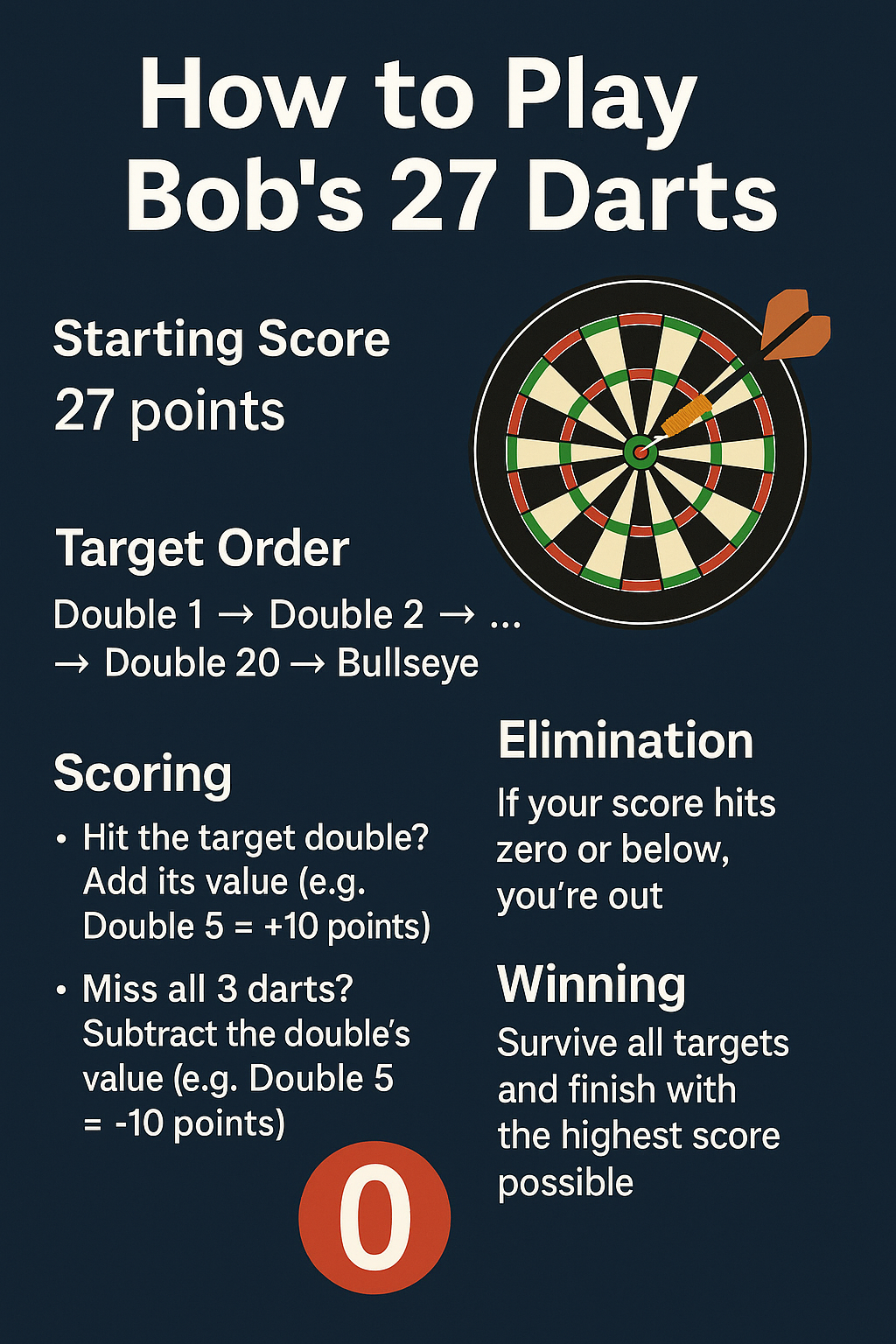
Dart players love to talk about scoring power—heavy trebles, 180s, and high averages. Yet, matches aren’t won by heavy scoring; they are won by finishing. Every serious player eventually discovers the same truth: your doubles determine your destiny. And there is no training routine more brutally effective at strengthening doubles than the legendary practice game Bob’s 27.
Bob’s 27 is not simply a drill. It is a mental pressure test, a neurological training routine, and a biomechanics challenge disguised as a game. You will fail it many times. You will get angry. You will lose more points than you gain. And that is exactly why it works.
If you commit to the method and practice it consistently, this drill will permanently raise your finishing ability—giving you the confidence to hit game-winning doubles when the board, the crowd, the scoreline, and your heart are all telling you to panic.
What Makes Bob’s 27 So Powerful?
Doubles Decide Everything
At the end of every 501 match, players are not judged by how many treble 20s they hit, but whether they can land one precise double. Your opponent can outscore you for four legs straight, and you can still win the match simply by finishing efficiently.
Bob’s 27 strengthens the key abilities necessary for finishing:
Accuracy under pressure
Rhythm recovery after misses
Landing the first dart closer to the wire
Understanding segment angles and shot mechanics
Developing calmness with small target zones
Why Bob’s 27 Works (Scientific Perspective)
It trains three systems simultaneously:
| Training System | Effect on Game | Example Pressure Situation |
|---|---|---|
| Motor Memory | Muscle-trained throwing precision | Setting up to hit D16 |
| Spatial Awareness | Target segmentation control | Adjusting after a miss |
| Stress Response Conditioning | Steady aim under adrenaline | Closing a 32 finish |
The brilliance of Bob’s 27 is that it forces the brain to solve the finishing problem under stress, not just with technique.
This is why even amateur players who master Bob’s 27 rapidly become dangerous finishers.
Complete Rules of Bob’s 27 (Explained Like a Coach)
Most websites describe the rules; few explain how to use them intelligently. Let’s break each rule down with its strategic purpose.
Starting with 27 Points
Why 27? Because:
It is enough to survive early mistakes.
It is low enough to trigger fear at any moment.
It forces tactical accuracy, not sloppy confidence.
If the game started with 100, it wouldn’t feel threatening. If it started with 10, survival would depend more on luck. 27 is the perfect psychological threshold.
Targeting Doubles 1 through 20, Then Bull
You must throw three darts maximum at each double in this order:
D1 → D2 → D3 → … → D20 → Bull
This forces equal respect for all doubles, not just favorites like D20 or D16.
Adding Points on a Hit
If you hit the correct double, you add the double’s value:
Hit D4 → Add +8
Hit D15 → Add +30
Hit D20 → Add +40
One hit is enough. Hits with the wrong double score zero, but do not penalize you.
Subtracting Points on a Miss
If you fail to hit the double with all three darts, you subtract the double’s value:
Miss D8 → −16
Miss D17 → −34
Miss D19 → −38
This is where fear lives. Bigger doubles mean bigger losses. This reflects real match tension, where a missed high double could cost a leg.
Game-Over Rule
If your score hits zero or below at any time, you are done.
Ending early teaches emotional recovery and pressure tolerance. You learn to protect your score, not just chase success.
Full Example of a Bob’s 27 Run
Let’s walk through an actual run step-by-step.
| Target | Result | Change | Score |
|---|---|---|---|
| D1 | Hit once | +2 | 29 |
| D2 | Miss all | −4 | 25 |
| D3 | Hit twice | +12 | 37 |
| D4 | Hit once | +8 | 45 |
| D5 | Miss all | −10 | 35 |
| D6 | Hit once | +12 | 47 |
| D7 | Miss all | −14 | 33 |
| D8 | Hit once | +16 | 49 |
| D9 | Miss all | −18 | 31 |
| D10 | Hit once | +20 | 51 |
| D11 | Miss all | −22 | 29 |
| D12 | Hit once | +24 | 53 |
| D13 | Miss all | −26 | 27 |
| D14 | Miss all | −28 | −1 — GAME OVER |
This example ended at D14. Many experienced players can’t reach D20 consistently. Some don’t survive past D10 during their first month. And that is exactly what makes Bob’s 27 transformative.
Biomechanics for Accurate Doubles
Doubles are small targets. To hit them consistently, you must control:
Release timing
Shoulder stability
Spine alignment
Finger pressure on release
Follow-through direction
Grip Mechanics
Use a stable but relaxed grip.
Increase pressure slightly just before release, not throughout the throw.
Keep fingers together on follow-through to avoid dart wobble.
Foot Positioning
Most weight on the front foot.
Back foot there only for balance.
Avoid leaning sideways; this introduces angular misalignment.
Eye Dominance and Aim
Find your dominant eye by pointing to a distant object with both eyes open, then closing one at a time. The eye that keeps the object aligned is dominant. Align dart aim using that eye, not both.
Follow-Through Integrity
Your hand should extend toward the exact wire on the board, not toward the center.
Great finishers don’t throw at the board. They throw through the segment.
If you need stance improvement, check Improve your darts stance
Psychological Warfare Within Bob’s 27
The game isn’t trying to test whether you can hit doubles. It’s trying to break your concentration. You must fight three enemies inside yourself:
1. The Panic After a Miss
Missing the first dart triggers emotional rush. Players tighten muscles, rush shots, and miss twice more.
Solution: Pause one second after every first dart.
2. Fear of High Doubles
Knowing that missing D20 costs 40 points increases tension.
Solution: Forget score value; aim with identical calmness.
3. Post-Failure Tilt
After losing 20-40 points, many players collapse psychologically.
Solution: Reset routine—shake your arm, breathe deeply, visualize the next hit.
To strengthen mental resilience, see mind tricks for darts (internal link #2).
The High-Risk Zone: Doubles 15–20
This is where most runs die. These doubles carry the biggest penalties and require sharper aim. Here’s how to survive:
Warm-Up Strategy
Before each Bob’s 27 session, spend 5–7 minutes hitting:
Double 16
Double 20
Double 8
These are common finishing doubles in 501. Perfecting them protects your score in Bob’s 27.
Bull Strategy (Advanced Risk Management)
At the end of the game, you must throw at the bull.
| Target | Score Impact |
|---|---|
| 🎯 Inner Bull | +50 |
| 🟢 Outer Bull | +25 |
| ❌ Miss All | −50 |
Smart Bull Protocol
If score is under 70, play safe and aim outer bull.
If score is over 100, attack inner bull confidently.
If score is between 70–100, adjust based on rhythm.
This teaches shot selection—the difference between good and great players.
Equipment Matters for Bob’s 27
Better equipment does not make you a better player, but it removes barriers. For example:
Best Board Qualities
Thin wiring
Minimal bounce-outs
Deep sisal compression
Good lighting
Good resource: Best dart board brands
Flight and Shaft Optimization
Doubles require stable trajectories, meaning:
| Component | Best For Doubles |
|---|---|
| Flights | Standard, tear-drop |
| Shafts | Medium or short |
| Dart Weight | 20–26g (steel), 18–22g (soft tip) |
Bad setup means drifting darts—harder to group near small double wires.
Advanced Training Variations of Bob’s 27
To improve much faster, use these progressive drills:
Variation A: Double Hit Streak Bonus
Every time you hit two or three darts in one double, add +10 bonus.
Variation B: Reverse Bob’s
Start from Bull → D20 → D19 → … → D1
This reveals weaknesses at high doubles under fresh concentration.
Variation C: Weak Spot Punishment
Every time you miss your known problem double, restart the entire run. Painful, powerful.
Variation D: Score Averaging
Track your score over 10 sessions. Aim to raise your average by 5% every week.
Most Common Mistakes Players Make
| Mistake | Consequence |
|---|---|
| Rushing after first dart miss | Panic ruins remaining darts |
| Throwing harder for “control” | Power destroys precision |
| Only practicing favorite doubles | Creates massive weaknesses |
| Changing stance mid-session | Messes up spatial memory |
| Bad lighting + shadows | Doubles visually shrink |
If lighting is a problem, see dartboard lighting
Progress Tracking System
Track:
| Metric | Why It Matters |
|---|---|
| Highest double reached | Measures endurance |
| Score before bull | Shows shot protection ability |
| Hits per session | Reveals real progress |
| Miss streaks | Shows psychological collapse points |
Suggested Tracking Chart
| Day | Final Score | Highest Double | Bull Result | Notes |
|---|---|---|---|---|
| Monday | 48 | D18 | Miss | Panicked after miss |
| Tuesday | 54 | D20 | Outer bull | Improved rhythm |
| Wednesday | 71 | Bull | Hit 25 | Better calm |
| Friday | 83 | Bull | 50 | Best form yet |
With consistent tracking, you will notice:
Panic decreases
Accuracy tightens
You start believing in your finish
That belief wins games.
Supplementary Games to Support Bob’s 27
To build a full finishing system, combine Bob’s 27 with:
Around the Clock Doubles
121 Checkout Practice
170 Ladder Drill
Castle Darts (for strategic punishment)
Learn finishing alternatives by exploring Best dart games for beginners
Final Conclusion: Bob’s 27 Will Change Your Game Forever
Bob’s 27 does not care how many 180s you can hit. It does not reward flashy scoring. It demands that you stand alone against your own fear, your own inconsistency, and your own impatience. The game does not get easier—you get stronger.
Through disciplined repetition, Bob’s 27 trains you to:
Throw calmly under pressure
Aim without panic
Recover emotionally after misses
Finish like a professional, not a casual player
Dart champions are not made by scoring ability. They are made by finishing confidence.
Master Bob’s 27, and you master the part of darts that truly wins matches.
🎯 Scoring power is loud. Finishing accuracy is lethal.